

Article by
Scott Ward MBA CCMI
Scott Ward is the founder and CEO of Humanise Solutions, which he established three years ago to help organisations elevate their people, leadership and culture through a human-centric, evidence-based approach. Before moving into business and academia, Scott spent seven years as a professional footballer, playing for Luton Town, Crawley Town and Coventry City FC until injury brought his playing career to a close — a turning point that shaped both his research interests and his approach to leadership.
Scott holds an MBA from Warwick Business School, where his research explored the causal relationship between trauma and decision-making — work that continues to inform how he supports young adults, leaders and teams under pressure. Recognised as a Companion of the Chartered Management Institute (CCMI), its highest grade of membership, he combines academic rigour with the discipline, resilience and team-first mindset of the professional game. At the heart of everything he does is a simple belief: that people perform at their best when they are led, developed and valued as human beings first.
Only 10% of UK employees feel fully engaged at work, a sobering reality that costs our economy billions in lost productivity every year. When your high-potential talent faces burnout and your managers struggle to bridge the gap between strategy and empathy, the traditional corporate playbook often falls short. You know that true excellence isn’t found in rigid hierarchies but in the quiet strength of a resilient team. This is why investing in leadership training for sustainable growth has become a non-negotiable priority for organisations that refuse to leave their future to chance. By shifting the focus from mere output to human flourishing, you can transform your workplace from a site of quiet quitting into a centre of psychological safety and innovation.
In this article, you’ll discover how to cultivate high-performing teams and drive long-term success through leadership training rooted in empathy and psychological science. We’ll explore the architecture of modern management, moving beyond generic coaching to a methodology that nurtures internal qualities like confidence and resilience. You’ll learn how a human-centric approach reduces staff turnover and builds a leadership pipeline capable of driving revenue through genuine excellence. It’s time to bridge the gap between current challenges and your team’s future potential by embracing a more compassionate way to lead.
Key Takeaways
- Learn how to redefine organisational success by prioritising human wellbeing alongside team excellence, ensuring your leadership training for sustainable growth creates a resilient foundation for scaling.
- Discover the evidence-based principles of decision-making and trauma prevention that underpin human-centric leadership, moving beyond generic coaching to foster deeper psychological safety.
- Address the impact of the UK’s NEET crisis, where 4.5% of 18-24-year-olds (807,000 people) are disengaged, and learn why 31% cite mental-health barriers as a primary obstacle.
- Gain a clear five-step framework for building a leading architecture that identifies leadership gaps and aligns bespoke learning outcomes with your strategic business goals.
- Explore how a science-driven approach to nurturing potential can reduce burnout and quiet quitting, transforming your workplace into a centre for human flourishing.
What is Leadership Training for Sustainable Growth?
Sustainable growth is the ability of an organisation to scale its impact and revenue whilst simultaneously protecting the wellbeing of its people. It moves beyond the narrow confines of environmental metrics to address the human architecture of a business. When we speak about leadership training for sustainable growth, we’re describing a shift from viewing employees as resources to be used and towards seeing them as potential to be cultivated. It is a deliberate architecture that aligns commercial ambition with the fundamental needs of the human spirit. Traditional leadership development often ignores the psychological foundations required for long-term endurance, focusing instead on tactical output.
In the current 2026 market, where staff turnover rates have climbed following a 19% average in 2025, the old extractive models are reaching a breaking point. These systems rely on high-pressure environments that prioritise immediate results over the health of the team. The result is a cycle of burnout and quiet quitting that erodes the very excellence a company seeks to achieve. True organisational resilience is built on the behaviour of its leaders; it requires a move towards nurturing leadership that values social connection and emotional intelligence as much as strategic acumen.
The Shift from Extractive to Nurturing Leadership
Command and control structures are increasingly obsolete. They create rigid environments where fear stifles creativity and high staff turnover becomes an accepted cost of doing business. By contrast, nurturing leadership prioritises empathy and psychological safety. This isn’t about being soft; it’s about creating a culture where people feel safe enough to take risks and innovate amongst diverse teams. When managers lead with warmth and evidence-based confidence, they build a self-sustaining talent pipeline. People stay where they feel they can flourish, turning recruitment from a constant fire-fight into a strategic advantage.
Sustainable Growth vs. Short-Term Gains
A churn and burn culture might deliver a strong quarterly report, but the hidden costs eventually devastate the bottom line. Replacing high-potential talent is expensive, and the loss of institutional knowledge is often immeasurable. Human-centric training is an investment in future succession planning, ensuring that the next generation of leaders is prepared to handle volatility without breaking. By developing nurturing leadership skills, organisations bridge the gap between where they are and where they want to be. This holistic approach to leadership training for sustainable growth ensures that the organisation remains robust even in shifting markets.
The Science of Human-Centric Leadership Development
Humanise Solutions bases its methodology on more than 12 years of rigorous research into decision-making and trauma prevention. This scientific foundation ensures that our leadership training for sustainable growth isn’t just a collection of soft skills, but a robust system for organisational excellence. We focus on creating a “leading architecture,” a structured approach designed to achieve specific, client-driven outcomes by aligning human biology with corporate strategy. When leaders understand the psychological mechanisms that drive team performance, they can move beyond reactive management into a state of visionary guidance.
The biological impact of inclusive leadership is profound. When a team feels truly seen and supported, the brain’s prefrontal cortex functions at its peak, allowing for higher-level problem solving and creativity. Our ILM-certified framework provides the gold standard for this development, offering a credible, science-backed alternative to generic corporate coaching. It’s about building a foundation that stays rooted in logic whilst reaching for the highest potential of the human spirit. This methodical approach ensures that change isn’t just temporary but deeply embedded within the organisation’s DNA.
Emotional Intelligence and Decision-Making
High-stakes business decisions are never made in a vacuum; they’re influenced by the emotional state and unconscious biases of the person making them. Emotional intelligence (EQ) is the essential tool for navigating these complexities. Training leaders to recognise and mitigate their own stress triggers prevents the neurological “hijack” that often leads to poor strategic choices. This level of self-awareness is a core component of the UN Executive Leadership Programme, which highlights how personal growth drives global sustainability. By addressing unconscious bias, leaders can foster a more diverse and innovative environment that directly fuels organisational growth and team excellence.
Trauma Prevention and Resilience in the Workplace
Modern leadership requires a deep understanding of trauma-informed practices. This doesn’t mean acting as a therapist, but rather creating an environment that prevents the accumulation of workplace stress and psychological harm. Building personal resilience amongst senior executives and emerging leaders is vital for long-term viability. When staff feel safe to excel, they’re more likely to contribute the kind of bold ideas that drive market leadership. We help organisations transition from high-pressure “survival” modes to thriving cultures of wellbeing where innovation can flourish. If you’re looking to implement this evidence-based approach within your own team, you might wish to connect with our specialist consultants to discuss your specific goals and aspirations.
Identifying the Barriers to Sustainable Organisational Growth
The most common objection we hear during a scaling phase is that there simply isn’t enough time for development. It’s an understandable sentiment, yet it misses a fundamental truth: growth without a solid human foundation is merely a countdown to burnout. Investing in leadership training for sustainable growth is not a distraction from your commercial goals; it is the very architecture that allows those goals to be reached safely and consistently. When we ignore the human element in favour of rapid expansion, we inadvertently create barriers that will eventually stifle our own progress and erode the excellence we’ve worked so hard to build.
The talent landscape is shifting rapidly, and the external environment presents challenges that leaders must be prepared to navigate. Currently, 4.5% of 18-24-year-olds in the UK are classified as NEET, which accounts for 807,000 young people who are not in education, employment, or training. This represents a significant loss of potential for the modern workforce. What is even more telling is that 31% of these young adults cite mental-health barriers as the primary reason for their disengagement. If managers lack the empathy and scientific understanding to support these individuals, the organisation suffers. Failing to prioritise building team excellence through inclusive practices leads to a stagnant culture where innovation cannot breathe.
The Hidden Costs of Disengaged Talent
Disengagement is a quiet drain on your bottom line. Whilst it might not appear on a balance sheet immediately, the cost of “quiet quitting” and high turnover is immense. Leadership training offers a clear ROI by stabilising your workforce and reducing the constant, expensive cycle of recruitment. When managers lack the soft skills to lead diverse teams, the mental health of their staff often declines, leading to further absenteeism. By contrast, a nurturing leader creates a sense of belonging amongst high-potential talent, ensuring they remain anchored to the organisation’s mission even during volatile periods.
Bridging the Skills Gap for Young Adults
Future-proofing your organisation requires a focus on the next generation of talent. Young adult professional development programmes are vital for creating a sustainable talent acquisition strategy that values social mobility. With a year-on-year increase of 65,000 NEET individuals in the UK, the need for better early-career leadership has never been more urgent. By integrating leadership training for sustainable growth into your early-career initiatives, you bridge the gap between social responsibility and commercial excellence. This proactive approach ensures you are not just filling roles, but cultivating a loyal, resilient leadership pipeline for the future.
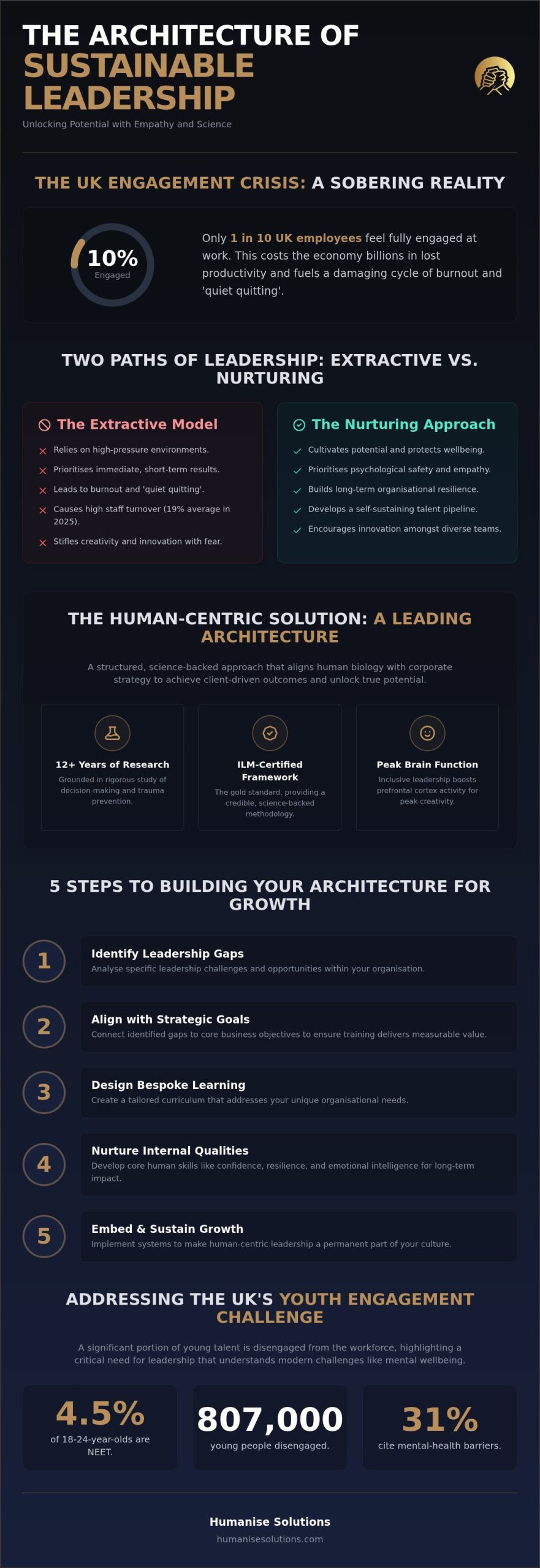
Building an Architecture for Growth: 5 Steps to Implementation
Transitioning from theory to practice requires a methodical, deliberate strategy. We call this building a leading architecture. It’s the framework that ensures your investment in leadership training for sustainable growth yields a tangible return. To achieve organisational excellence, you must move through a logical sequence of development that respects both your commercial goals and your people’s wellbeing.
The implementation process begins with a comprehensive organisational design audit. You can’t fix what you haven’t measured; this step identifies specific leadership gaps and cultural bottlenecks. Once identified, we define bespoke learning outcomes that align directly with your business strategy. This ensures that every hour spent in training is an hour spent solving a real-world business challenge. The following steps complete the architecture:
- Implement certified ILM programmes: Establish a gold-standard benchmark for leadership across the whole firm to ensure consistency during scaling.
- Integrate resilience modules: Embed wellbeing tools into daily operations so that mental health support becomes a core operational function rather than a peripheral benefit.
- Measure impact: Use performance data and feedback ratings to track progress. Our delivery consistently achieves a 9.98/10 feedback rating, proving that a human-centric approach delivers excellence.
Bespoke Learning Design for UK Firms
Off-the-shelf training often feels sterile and detached. It usually fails to address the unique cultural nuances and challenges faced by modern UK organisations. By tailoring bespoke learning and development programmes, you ensure the content resonates deeply with your team’s specific needs. For senior leaders, 1-1 coaching is particularly effective. It provides a safe space for deep transformation, allowing executives to refine their personal leading architecture in a way that generic workshops cannot match.
Integrating Women in Leadership Tracks
A truly sustainable organisation is an inclusive one. There are specific, documented benefits to empowering women in the workplace, from improved financial performance to enhanced team dynamics. Our programmes focus on building inner confidence and providing tools to overcome imposter syndrome, which often holds back high-potential female talent. By creating an inclusive pipeline for executive roles, you’ve secured a robust succession plan that reflects the diversity of the modern market. If you’re ready to build a more resilient leadership pipeline, you can speak with our transition specialists to start your organisational audit.
Humanise Solutions: Elevating People, Leadership, and Culture
Our mission is simple yet profound: to enhance the human experience in every interaction. We believe that when people feel valued and understood, excellence follows naturally. As the 5th largest digital recruiter in EMEA, Humanise Solutions provides a unique end-to-end talent pipeline that bridges the gap between initial recruitment and long-term development. This dual expertise allows us to view organisational health through a holistic lens, ensuring that our leadership training for sustainable growth is grounded in the real-world dynamics of the modern workforce. We don’t just fill roles; we cultivate the environments where those individuals can thrive for years to come.
A Scientific and Empathetic Methodology
Our approach is shaped by a unique blend of workplace psychology and the discipline of high-performance sport. This philosophy was co-founded by Serena Kersten MBE and Scott Ward, whose combined expertise ensures our nurturing leadership model is both aspirational and pragmatic. We move beyond theory by applying over 12 years of research into decision-making to the daily realities of management. By fostering wellbeing at work, we help organisations unlock latent potential and drive performance through empathy. This scientific methodology ensures that resilience becomes a measurable asset rather than a vague concept.
Your Partner in Sustainable Transformation
We have served a diverse range of clients, from elite sport organisations to global corporate teams, helping each one transition toward a more human-centric architecture. Our commitment to participant success begins with a rigorous three-day onboarding process, setting a clear stage for meaningful change. Whether you require bespoke workshops or long-term consultancy, we position ourselves as a partner in your journey of development. Our results speak for themselves, with a 100% programme completion rate and a 9.98/10 feedback rating for delivery. If you’re ready to elevate your culture, we invite you to explore our services for a bespoke consultation tailored to your specific goals. Choosing the right partner for leadership training for sustainable growth is the first step toward a future of enduring organisational excellence.
Cultivate Your Future Potential
True organisational excellence is born from the deliberate choice to put people at the heart of your strategy. By embracing leadership training for sustainable growth, you transition from traditional, extractive management to a nurturing model that unlocks latent potential. We’ve explored how a robust leading architecture, grounded in 12 years of psychological research, can solve modern challenges like high turnover and disengagement. You now have the framework to bridge the gap between current performance and your team’s highest potential.
As the 5th largest digital recruiter in EMEA, Humanise Solutions is your partner in this transformative journey. Our ILM-certified programmes boast a 100% completion rate and a 9.98/10 feedback rating, reflecting our commitment to evidence-based excellence. It’s time to move beyond generic coaching and build a culture where everyone can flourish. Elevate your leadership and culture with Humanise Solutions today. The journey to a more resilient, empathetic, and high-performing organisation starts with a single, purposeful step. Your team’s future is waiting to be unlocked.
Frequently Asked Questions
What is the ROI of leadership training for sustainable growth?
The ROI of leadership training for sustainable growth is measured through both financial and human capital gains. Research indicates that for every £1 invested in leadership development, organisations see an average return of £2.86. This value is realised through reduced recruitment costs, higher employee engagement, and increased productivity. By stabilising your workforce and nurturing internal talent, you create a self-sustaining cycle of excellence that directly impacts your bottom line whilst ensuring long-term organisational viability.
How does human-centric leadership differ from traditional management training?
Human-centric leadership differs from traditional management by prioritising the psychological and biological needs of the team. Whilst traditional models often rely on extractive “command and control” methods, our approach focuses on nurturing leadership and psychological safety. This transition creates an environment where innovation thrives because staff feel safe to take risks. By using evidence-based methodology rooted in decision-making science, you build a resilient architecture that supports human flourishing rather than just short-term output.
Can leadership training help with employee retention in the UK?
Yes, leadership training is a powerful tool for improving employee retention in the UK. With average staff turnover reaching 19% in 2025, organisations must address why talent leaves. Training managers in empathy and soft skills directly counters “quiet quitting” and burnout. When leaders are equipped to support diverse teams and foster wellbeing, they build deeper social connections. This sense of belonging anchors high-potential employees to the business, significantly reducing the costs of constant recruitment.
What are the core competencies of a sustainable leader?
A sustainable leader possesses a blend of emotional intelligence, cognitive flexibility, and trauma-informed awareness. They must be capable of building a leading architecture that aligns team wellbeing with strategic business goals. Key competencies include:
- Self-awareness to mitigate unconscious bias and stress triggers.
- The ability to foster psychological safety amongst diverse, modern teams.
- Personal resilience to navigate volatile markets whilst maintaining stability for their staff.
These skills ensure that growth is achieved without sacrificing the human spirit.
How long does a bespoke leadership development programme take to implement?
The implementation of a bespoke leadership development programme is a methodical process that prioritises care over speed. It begins with a thorough organisational design audit to identify specific leadership gaps and cultural needs. Our journey typically starts with a rigorous three-day onboarding process to set the foundation for participant success. The total duration depends on the complexity of your strategic goals, as we ensure that every learning outcome is directly aligned with your unique business architecture.
Is leadership training suitable for small businesses or just global corporates?
Leadership training is vital for organisations of all sizes, from small businesses to global corporates. Whilst the scale of the challenge might differ, the fundamental human needs remain the same. Small firms often find that human-centric training provides the stability needed to scale effectively without losing their core culture. Humanise Solutions has successfully partnered with elite sport organisations and corporate teams alike, proving that a scientific approach to nurturing potential works across every professional context.
How does Humanise Solutions incorporate wellbeing into leadership training?
Humanise Solutions treats wellbeing as a core operational function rather than a peripheral benefit. We integrate 12 years of research into decision-making and trauma prevention directly into our curriculum. This scientific approach helps leaders recognise stress triggers and build personal resilience. By embedding wellbeing modules into daily operations, we ensure that mental health support is a natural part of the leadership behaviour. This creates a culture of psychological safety where staff feel empowered to excel and innovate.
What role does social mobility play in sustainable organisational growth?
Social mobility is a strategic driver of sustainable organisational growth and future-proofing. By addressing the UK’s NEET crisis, where 807,000 young people are currently disengaged, businesses can tap into a vast, underserved talent pool. Sustainable leaders recognise that 31% of these individuals cite mental-health barriers as a primary obstacle. By creating inclusive early-career programmes and supporting social mobility, you build a diverse leadership pipeline that brings fresh perspectives and long-term resilience to your organisation.
