Article by
Scott Ward MBA CCMI
Scott Ward is the founder and CEO of Humanise Solutions, which he established three years ago to help organisations elevate their people, leadership and culture through a human-centric, evidence-based approach. Before moving into business and academia, Scott spent seven years as a professional footballer, playing for Luton Town, Crawley Town and Coventry City FC until injury brought his playing career to a close — a turning point that shaped both his research interests and his approach to leadership.
Scott holds an MBA from Warwick Business School, where his research explored the causal relationship between trauma and decision-making — work that continues to inform how he supports young adults, leaders and teams under pressure. Recognised as a Companion of the Chartered Management Institute (CCMI), its highest grade of membership, he combines academic rigour with the discipline, resilience and team-first mindset of the professional game. At the heart of everything he does is a simple belief: that people perform at their best when they are led, developed and valued as human beings first.
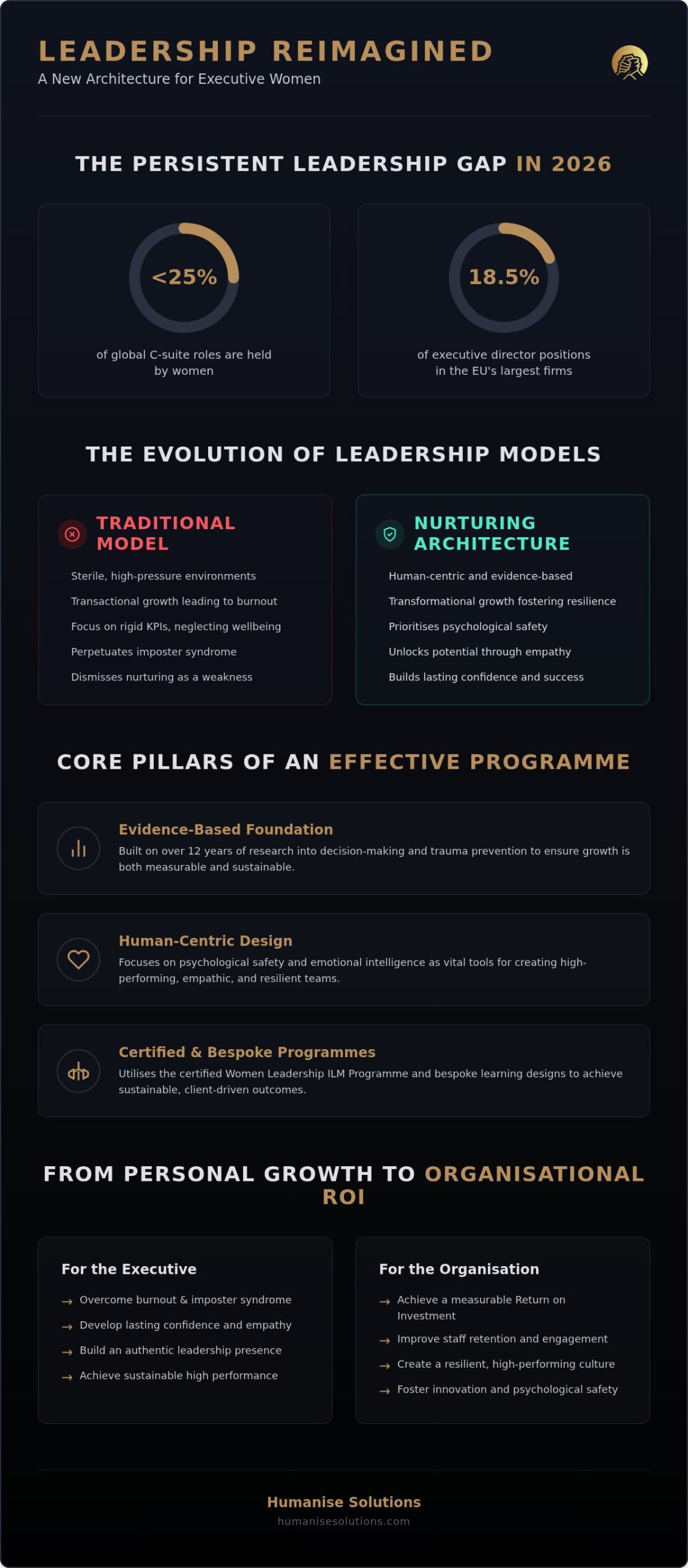
Did you know that as of mid-2026, women still hold fewer than 25% of global C-suite roles, whilst executive director positions in the EU’s largest firms sit at just 18.5%? This statistic reveals a persistent gap that traditional corporate training has failed to bridge, making the search for meaningful leadership development for executive women more critical than ever. You’ve likely felt the exhaustion of trying to thrive within high-pressure models that often overlook personal wellbeing or dismiss nurturing behaviours as weaknesses. It’s a common struggle to balance high achievement with the quiet hum of imposter syndrome, especially when the surrounding culture feels disconnected from your core values.
We believe there’s a more sustainable path to excellence. This guide will show you how a nurturing, evidence-based approach can help you unlock your full potential and transform your organisational culture from the inside out. We’ll explore the transition from burnout to resilience, the power of human-centric growth, and how a certified ILM programme can provide the structural support you need to lead with lasting confidence and empathy.
Key Takeaways
- Understand the shift from sterile corporate models to a nurturing architecture that prioritises human flourishing and psychological wellbeing.
- Learn how 12 years of research into decision-making and trauma prevention can help you build more resilient and high-performing executive teams.
- Explore the benefits of the Women Leadership ILM Programme as a certified track for meaningful leadership development for executive women.
- Discover how fostering a culture of wellbeing at the top level directly improves staff retention and delivers a measurable return on investment.
- Find out why bespoke learning designs that leverage recruitment market insights are essential for achieving sustainable, client-driven outcomes in 2026.
The Evolution of Leadership Development for Executive Women in 2026
2026 marks a significant turning point in how we perceive professional growth. We’ve moved past the era of sterile, detached corporate consulting that often treated leaders as interchangeable parts of a machine. True leadership development for executive women is now understood as a holistic process that prioritises the elevation of people alongside the growth of the business. It’s about building a leading architecture that supports human potential rather than just managing technical output.
Traditional models often failed because they ignored the psychological foundations of excellence. They focused on rigid KPIs whilst neglecting the human flourishing that actually drives those numbers. By replacing these cold structures with human-centric designs, organisations in the UK are creating spaces where empathy is a requirement for sustainable success. This shift isn’t just about being “nice”; it’s about unlocking potential with a methodical, evidence-based approach that respects the individual’s journey.
Why Nurturing Leadership is the New Gold Standard
Nurturing leadership represents a shift from control to cultivation. It’s a sophisticated competency that fosters team excellence by grounding professional goals in human needs. At Humanise Solutions, we’ve spent over 12 years researching decision-making and trauma prevention to ensure our programmes are rooted in both logic and empathy. This evidence-based approach is vital for leaders navigating complex social dynamics.
Understanding the nuances of Sex and gender differences in leadership helps us move beyond outdated stereotypes. It allows us to focus on what actually drives high performance: connection, trust, and psychological safety. When leaders nurture their teams, they don’t just see better results; they see higher retention and a more vibrant, resilient workplace culture.
The Shift from Transactional to Transformational Growth
The “old-school” approach to management was often transactional and high-pressure. It frequently led to the burnout and imposter syndrome that many executive women still face today. Transformational growth, however, starts with unlocking potential through empathy. It’s a visionary path that values emotional intelligence as much as strategic foresight. It recognises that a leader’s wellbeing is the foundation of their team’s success.
By consciously developing nurturing leadership skills, women can lead the charge in creating inclusive environments that celebrate diverse strengths. Modern leadership development for executive women is no longer about fitting into a pre-defined mould; it’s about redefining excellence through the lens of human connection. This transition isn’t accidental; it’s the result of a deliberate, methodical commitment to human-centric values that align personal growth with organisational ROI.
The Psychology of Executive Growth: An Evidence-Based Approach
Excellence isn’t accidental. It’s the result of a deliberate, scientific understanding of how humans function under pressure. At Humanise Solutions, our approach to leadership development for executive women is anchored in over 12 years of research into decision-making and trauma prevention. We don’t just teach management; we build the psychological foundations that allow high-performing women to thrive without sacrificing their wellbeing. This evidence-based methodology ensures that growth is both measurable and sustainable.
When we look at the architecture of a high-performing team, psychological safety is the cornerstone. It’s the factor that allows executive women to lead with authentic confidence rather than a forced persona. Emotional intelligence isn’t a secondary “soft skill” in this context. It’s a vital tool for organisational design, allowing leaders to create environments where potential is unlocked through empathy. This alignment between human needs and corporate goals is what defines a truly modern leader.
The Role of Trauma Prevention in Leadership
In a professional context, trauma prevention is about more than just recovery. It’s a proactive strategy to prevent chronic stress and burnout from taking root in senior leadership tiers. By examining the mechanics of decision-making, we can identify exactly where pressure turns into paralysis. This allows executives to design workflows and social dynamics that protect their mental energy.
- Proactive Burnout Mitigation: Implementing systems that recognise early signs of chronic stress.
- Decision-Making Clarity: Using research-backed frameworks to maintain objective focus during crises.
- Resilience Building: Prioritising self-care as a non-negotiable strategic asset for career longevity.
Understanding these processes leads to better executive outcomes because it removes the friction of emotional exhaustion. When you lead from a place of resilience, your ability to foster wellbeing within your own team increases exponentially.
Overcoming Imposter Syndrome through Scientific Insight
Imposter syndrome is frequently mislabelled as a personal deficit. In reality, it’s often a systemic response to environments that haven’t traditionally valued nurturing behaviours or inclusive leadership styles. Reframing these challenges through evidence-based coaching helps women see their unique strengths as strategic assets rather than anomalies. Our mindset toolkit specifically addresses the internal shift in attitude and perspective required to lead with unwavering presence.
By using logic and methodology to dismantle self-doubt, we empower leaders to occupy their roles with a sense of grounded authority. This transition from feeling like an outsider to becoming a visionary guide is the heart of transformational growth. If you’re ready to explore how these scientific insights can support your journey, you might want to connect with our team for a deeper conversation about your bespoke needs.
Core Pillars of an Effective Female Leadership Development Programme
High-impact leadership development for executive women requires more than just a curriculum; it demands a leading architecture designed for the highest tiers of corporate performance. We view the boardroom as a space for athlete-level execution. This is why bespoke 1-1 coaching is a non-negotiable pillar of our approach. It provides the personalised support needed to navigate complex social dynamics whilst maintaining personal wellbeing. When learning is client-driven, the outcomes aren’t just theoretical; they’re immediately applicable to the specific cultural challenges of your organisation.
Effective programmes must move beyond generic management training. They should be built on a foundation of human-centric values that prioritise both professional growth and psychological health. By focusing on these core pillars, organisations can ensure that their senior leaders are equipped to lead with both authority and empathy. This creates a ripple effect, where the confidence of a single executive woman can elevate the performance and morale of her entire team.
The Women Leadership ILM Programme
Professional rigour is essential for growth at the executive level. A certified track like the Women Leadership ILM Programme offers the formal recognition that senior roles demand, providing a structured framework for excellence. It isn’t just about the qualification; it’s about the scientific methodology and psychological depth behind the learning. These programmes are vital components of wider initiatives for empowering women in the workplace, ensuring that development is backed by a recognised, evidence-based standard. Our 100% completion rate for these programmes is a testament to an engaging design that respects the intense schedules of busy executives.
Inclusive Leadership and Team Excellence
True excellence goes beyond hitting diversity metrics. It requires a shift towards inclusive leadership that fosters a genuine sense of belonging across all levels of the firm. There’s a powerful, proven link between building team excellence and the nurturing behaviours often championed in female leadership styles. By moving away from aggressive management, leaders can create high-performing units that thrive on trust and psychological safety.
Our WIB (Women in Business) modules emphasise the importance of mentoring and “paying it forward”. This isn’t just a philanthropic gesture; it’s a strategic move to build a resilient internal talent pipeline. When executive women mentor others, they reinforce their own leadership skills whilst cultivating the next generation of talent. This cycle of growth ensures that the benefits of leadership development are felt long-term, creating a sustainable culture of excellence and mutual support.
Implementing Sustainable Change: From Personal Growth to Organisational ROI
Investing in leadership development for executive women isn’t just a moral choice; it’s a strategic necessity that directly influences the bottom line. When senior leaders feel supported and nurtured, the ripple effect on staff turnover is profound. High-performing women who operate within a leading architecture of empathy are far more likely to remain within an organisation, significantly reducing the costs associated with executive search and onboarding. In 2026, retention is no longer just about salary; it’s about the quality of the human experience at work.
Transitioning from individual growth to full-scale culture transformation requires a methodical approach to succession planning. By cultivating internal talent through human-centric frameworks, firms can build a resilient pipeline that is prepared for future transitions. This strategic management of potential ensures that the values of inclusive excellence are woven into the very fabric of the company, rather than being treated as a one-off initiative. It’s about creating a legacy of excellence that survives the departure of any single leader.
Measuring the Impact of Human-Centric Training
We believe that logic and methodology should always support aspirational goals. Our 9.98% feedback rating for programme delivery serves as a benchmark for high-quality engagement, proving that human-centric training resonates deeply with executive audiences. To ensure these results translate into long-term success, we utilise a matrix partner system. This framework provides the structural support needed to integrate new behaviours into daily operations, moving beyond the initial “spark” of a workshop to achieve lasting change.
Rigorous training evaluation and regular performance reviews are essential for measuring this growth. By tracking specific metrics related to team cohesion and individual resilience, organisations can see the clear ROI of their investment. This evidence-based confidence allows boards to commit to leadership development for executive women as a core driver of their commercial strategy.
Wellbeing as a Strategic Driver of Performance
Excellence cannot be sustained in an environment of chronic stress. This is why fostering wellbeing at work has become a primary focus for modern UK boards. Addressing essential topics like menopause awareness and dignity at work isn’t just about compliance; it’s about building a resilient organisational design that respects the biological and psychological realities of its leaders. When these factors are ignored, the risk of burnout increases, threatening the stability of the entire executive team.
Managing stress proactively allows leaders to maintain their clarity and decision-making abilities during periods of intense change. Personal resilience is the foundation upon which organisational resilience is built. By prioritising self-care and psychological safety, executive women can lead their teams through transitions with a sense of grounded authority and calm. If you’re ready to transform your organisational culture through a bespoke, human-centric programme, we invite you to start a conversation with us today.
Choosing the Right Partner for Women’s Leadership Development
Selecting a partner for leadership development for executive women is a decision that shapes the future of your firm’s culture. Whilst many institutions offer prestigious, off-the-shelf courses, these often lack the intimate, bespoke partnership model required to drive meaningful change. A generic programme might provide theory, but it rarely addresses the specific psychological and systemic barriers your leaders face daily. In contrast, a human-centric partner works as an extension of your team, aligning every module with your unique organisational goals.
The advantage of working with a consultancy that understands the broader talent market is significant. Being the 5th largest digital recruiter in EMEA gives us a unique window into the evolving needs of the workforce. We don’t just see leadership in a vacuum; we see the entire talent pipeline. This perspective allows us to design training that not only elevates current executives but also prepares the ground for the next generation of talent. It ensures your leading architecture is grounded in real-world recruitment insights and long-term sustainability.
The Humanise Solutions Differentiator
Our approach is defined by a unique blend of workplace psychology and the discipline of high-performance sport. Led by experts like Serena Kersten MBE, we bring the rigour of elite performance into the corporate boardroom. This isn’t just about theory; it’s about the practical application of resilience and excellence under pressure. We specialise in bespoke learning and development programmes that are built from the ground up to meet your specific needs.
By focusing on the human experience, we ensure that growth is sustainable. This commitment to long-term flourishing extends beyond the C-suite. Our work in young adult professional development ensures that your organisation is future-proofed, creating a consistent culture of empathy and excellence from entry-level to executive roles. We believe in unlocking potential at every stage of the professional journey.
Taking the Next Step Towards Excellence
Transforming your leadership pipeline begins with a single, focused conversation. We invite you to explore how a leading architecture of empathy can unlock the latent potential within your executive team. Our mission is to enhance the human experience in every interaction, ensuring that your leaders feel supported, valued, and empowered to lead with authenticity. This transition from high-pressure management to nurturing leadership is the key to lasting success.
Choosing the right partner means finding a guide who is as invested in your people as you are. We combine scientific methodology with empathetic warmth to create a journey of development that is both rigorous and reassuring. To begin your transition towards a more human-centric organisation, Contact Humanise Solutions to discuss your bespoke leadership track. We look forward to helping you cultivate a culture where everyone can thrive.
Cultivating the Future of Human-Centric Leadership
The transition from traditional, high-pressure management to a more empathetic, leading architecture is not just a trend; it’s a vital evolution for 2026. True excellence is found when we align professional ambition with human flourishing. By grounding leadership development for executive women in over 12 years of research-backed methodology, we ensure that growth is both psychologically safe and commercially impactful. Our 100% programme completion rate reflects a design that truly resonates with the lived experience of senior leaders, providing the structural support needed to thrive in complex environments.
We’ve seen that when you prioritise wellbeing and nurturing behaviours, you don’t just reduce burnout; you build a more resilient organisational ROI. With a 9.98% average feedback rating for our certified programmes, our approach is proven to deliver the transformation you seek. It’s time to move beyond sterile corporate training and embrace a path that values your full potential and internal confidence. Your journey toward sustainable excellence starts with a commitment to human-centric values.
Elevate your leadership and culture – contact our expert team today. We are ready to partner with you on this visionary journey to unlock lasting growth and resilience.
Frequently Asked Questions
What should a leadership development programme for executive women include?
A comprehensive programme should include bespoke learning modules that align with specific, client-driven outcomes alongside certified tracks like the ILM. It is vital to address the unique psychological and systemic challenges faced by women in senior roles through athlete-level 1-1 coaching. By integrating workplace psychology with practical leadership skills, these programmes foster sustainable growth and resilience, ensuring that participants can lead with both authority and empathetic warmth.
How does an ILM programme benefit female leaders in the UK?
An ILM programme provides a recognised, high-impact framework that offers professional rigour and formal recognition for senior leaders. It allows participants to validate their expertise whilst developing advanced management competencies through a scientific, evidence-based lens. For those seeking leadership development for executive women, this certification ensures the training meets a global standard of excellence, providing the structural support needed to navigate complex organisational architectures with confidence and clarity.
Can leadership training help with imposter syndrome in the boardroom?
Yes, targeted training helps reframe imposter syndrome as a systemic response rather than a personal deficit. By using evidence-based coaching and our mindset toolkit, leaders can dismantle self-doubt and reclaim their authentic presence. This process involves identifying the logic behind one’s achievements and using psychological safety to build inner resilience. When women understand that their nurturing behaviours are strategic assets, they can occupy their roles with grounded authority and visionary guide qualities.
Why is a human-centric approach better than traditional corporate training?
Traditional corporate training often uses sterile, detached language that treats people as interchangeable parts of a machine. A human-centric approach, however, prioritises human flourishing and psychological wellbeing. It recognises that sustainable excellence is achieved by unlocking potential with empathy rather than relying on aggressive, high-pressure management styles. This nurturing architecture leads to better decision-making and deeper social connections, creating a more vibrant and resilient workplace culture that benefits everyone involved.
What is the ROI of investing in women leadership development?
The return on investment is seen through significantly reduced staff turnover and improved talent retention at the senior level. When organisations invest in leadership development for executive women, they foster a culture of inclusive excellence that ripples through every tier of the business. This leads to more stable executive teams, better succession planning, and a measurable increase in overall performance. Human-centric training ensures that the high costs of executive recruitment are mitigated by sustainable internal growth.
How does trauma prevention relate to executive performance?
Trauma prevention in a workplace context involves proactively managing chronic stress and burnout to protect a leader’s mental energy. Our 12 years of research into decision-making show that high-pressure environments can impair objective focus if not managed carefully. By designing workflows that prioritise resilience and psychological safety, executives can maintain athlete-level performance even during crises. This proactive strategy ensures that leaders remain clear-headed and capable of leading their teams through periods of intense change.
What makes Humanise Solutions different from other UK leadership consultancies?
We offer a unique blend of workplace psychology and high-performance sport experience, led by experts like Serena Kersten MBE. Unlike generic consultancies, we integrate insights from our position as the 5th largest digital recruiter in EMEA to build bespoke, client-driven programmes. Our 9.98% feedback rating and 100% completion rate prove our ability to engage senior leaders effectively. We don’t just provide training; we partner with you to build a leading architecture of empathy.
How can organisations support the transition of women into senior executive roles?
Organisations can support this transition by creating inclusive environments that value nurturing leadership and provide formal mentoring opportunities. It is essential to address systemic barriers like menopause awareness and dignity at work, ensuring that senior roles are sustainable for women. By implementing bespoke learning tracks and fostering a culture of wellbeing, firms can build a resilient pipeline of female talent. This approach moves beyond diversity metrics to achieve true transformational growth and organisational excellence.